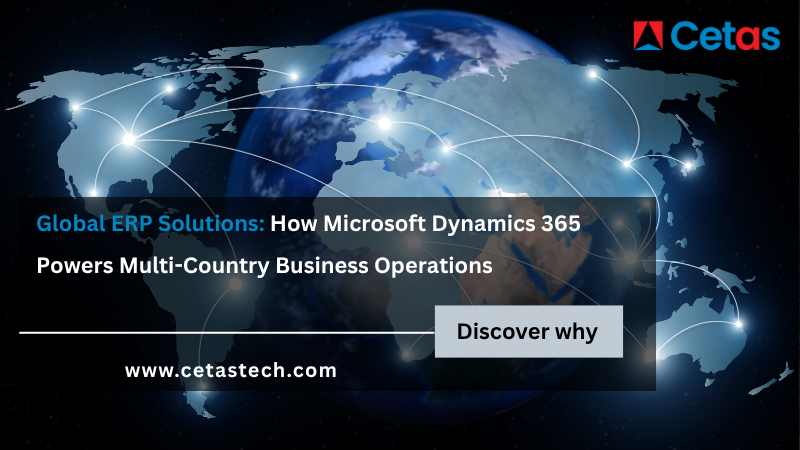
When a business expands across borders, its operational complexity multiplies overnight. Subsidiaries in different countries, currencies, tax regimes, regulatory environments, and languages all need to communicate in real time. This is exactly the challenge that global ERP solutions are designed to solve.
For business owners, CFOs, IT managers, and operations leaders evaluating their options, the right global ERP platform is not a back-office tool. It is the strategic backbone that determines how fast your organisation can make decisions, scale into new markets, and stay compliant without burning internal resources.
Microsoft Dynamics 365 ERP is purpose-built for this challenge. According to Gartner, the global ERP software market reached USD 73 billion in 2025 and is projected to exceed USD 81 billion by 2026, driven by cloud adoption, generative AI, and demand for real-time cross-border operational visibility. Organisations that delay the transition from legacy or siloed systems are increasingly at a competitive disadvantage.
What Global ERP Solutions Actually Mean
A global ERP solution is an integrated software platform that unifies core business functions across geographies, legal entities, currencies, and time zones. Functions covered include finance, procurement, supply chain, operations, human resources, and customer engagement.
The defining characteristic is unification. Many organisations running international operations rely on a patchwork of regional systems like an accounting tool in one country, a separate inventory platform in another, and manual spreadsheets bridging the gaps. The result is fragmented data, reporting delays, and decisions made on stale information.
A cloud-based global ERP like Microsoft Dynamics 365 eliminates that fragmentation. Every entity works from a single system of record, with real-time visibility into performance across every location and function.
Supply chain volatility, cross-border compliance requirements, and rising customer expectations have made legacy siloed systems a competitive liability. Organisations that cannot consolidate operational data in real time are slower to respond to disruption, more exposed to compliance risk, and less able to support strategic growth decisions.
What Microsoft Dynamics 365 ERP Delivers as a Global ERP Solution
1. Multi-Country Localisation Built In
Microsoft Dynamics 365 ERP operates on a two-tier localisation framework. Microsoft directly delivers first-party regulatory localisation for 40-plus countries, covering tax codes, financial reporting formats, banking standards, and compliance workflows. Through certified partner-led localisation apps on AppSource, Dynamics 365 Business Central extends availability to more than 170 countries and regions worldwide.
Organisations expanding into new markets do not need to rebuild their ERP configuration from scratch. They activate the relevant localisation layer and operate within local regulatory requirements from day one. Microsoft continuously expands this coverage; built-in localisation for Türkiye was introduced in the 2025 Release Wave 2 as a recent example.
2. Native Multi-Currency and Intercompany Accounting
Microsoft Dynamics 365 handles multi-currency operations natively. Exchange rate management, transaction-level currency conversion, intercompany eliminations, and consolidated financial reporting across legal entities are all handled within the same system. Finance teams consistently report month-end close time reducing from three to five days down to same-day or next-day reporting after a structured Dynamics 365 deployment.
3. Cloud Scalability Without Infrastructure Investment
As a cloud ERP platform, Microsoft Dynamics 365 scales on demand. Organisations can add new legal entities, geographies, and user counts without a corresponding infrastructure overhaul. Microsoft manages the underlying infrastructure, security patching, and platform updates through a continuous update model with monthly quality releases and quarterly version updates.
4. Real-Time Reporting and the AI-Powered Immersive Home Workspace
Microsoft Dynamics 365 integrates natively with Microsoft Power BI, enabling real-time dashboards across financial performance, supply chain status, inventory levels, and operational KPIs. The 2026 release wave also introduced Immersive Home, an AI-powered adaptive workspace for agent management and workflow monitoring, giving finance and operations leaders a single intelligent environment that surfaces real-time alerts, agent activity, and business insights together.
5. Agentic AI and Microsoft Copilot
Microsoft has shifted Dynamics 365 from Copilot as a chat assistant to a platform of autonomous AI agents that reason over ERP data, execute multi-step workflows, and act with minimal human input. As of the 2026 Release Wave 1, key agents available in production include:
- Finance Agent: helps finance teams interact with ERP data directly within Microsoft Excel and Outlook, supporting reconciliation, variance analysis, and customer communications
- Supplier Communication Agent: automates vendor interactions within Dynamics 365 Supply Chain Management
- Payflow Agent: handles accounts payable workflows autonomously end-to-end
- Natural Language ERP Queries via MCP: Microsoft’s Model Context Protocol server for Dynamics 365 Finance and Operations allows any compatible AI agent to query ERP data using plain-language instructions without custom API development
Dynamics 365 is no longer just recording what happened. It actively participates in making things happen within controlled, auditable, permission-aware structures.
Global ERP Solutions Compared
| Factor | Legacy On-Premises ERP | Microsoft Dynamics 365 ERP |
| Infrastructure | Internally owned and managed servers | Microsoft-managed cloud, no hardware needed |
| Localisation | Manual, costly per-country configuration | 40+ Microsoft-led countries; 170+ via partner ecosystem |
| Multi-currency | Often requires third-party add-ons | Native real-time currency and FX management |
| Scalability | Hardware investment per new entity | Elastic scaling, add users and entities instantly |
| AI capabilities | Limited or none | Autonomous AI agents across all modules including Finance Agent, Supplier Agent, Payflow Agent, and MCP natural language queries |
| Reporting | Periodic batch reporting | Real-time Power BI dashboards plus AI-powered Immersive Home workspace |
| Compliance updates | Manual IT effort per regulation change | Microsoft delivers rolling compliance updates automatically |
Key Considerations When Evaluating Global ERP Solutions
1. Compliance Depth and Update Frequency
Evaluate the vendor’s localisation track record, the frequency with which compliance updates are released, and whether those updates are delivered automatically as part of the cloud subscription or require a separate implementation engagement.
2. Integration with Existing Business Systems
Microsoft Dynamics 365 benefits from native integrations across Microsoft Azure, Microsoft 365, Microsoft Teams, and an extensive library of pre-built partner connectors. MCP server support also means Dynamics 365 can be queried and operated by any compatible AI agent, reducing integration complexity compared to platforms relying primarily on bespoke API connections.
3. Implementation Partner Quality
ERP deployments that fail to deliver value almost always trace back to poor requirements definition, inadequate data migration planning, or insufficient user adoption support. Microsoft’s FastTrack for Dynamics 365 programme provides direct engineering support for qualifying deployments and can compress timelines for standard configurations. The partner’s methodology, industry experience, and post-go-live support model are at least as important as the platform itself.
Where Global ERP Solutions Generate the Strongest ROI
1. Financial Consolidation and Group Reporting
Organisations that previously spent three to five days on group consolidation typically see that process compress to same-day or next-day reporting. The Finance Agent accelerates this further by handling reconciliation, variance analysis, and data preparation autonomously within Excel and Outlook.
2. Supply Chain Visibility Across Locations
A multi-country ERP gives procurement and logistics teams a unified view of inventory, purchase orders, and supplier performance across all locations. The Supplier Communication Agent reduces manual vendor follow-up, improves lead time accuracy, and supports better sourcing decisions under uncertain conditions.
3. Regulatory Compliance at Scale
Automating country-specific tax filings, transfer pricing documentation, and statutory reports through a properly configured global ERP reduces both the labour cost and the compliance risk associated with manual processes. Microsoft’s continuous compliance update model ensures localisation stays current without requiring a separate implementation engagement each time regulations change.
Cetas, a Microsoft Dynamics 365 Global ERP Implementation Partner
Cetas is a Microsoft Solutions Partner and Independent Software Vendor with deep specialisation in Microsoft Dynamics 365 ERP implementations across manufacturing, distribution, retail, and professional services industries.
Our delivery approach is built around business outcomes rather than system configuration alone. We work with finance, operations, and IT leaders to define what a successful deployment looks like in practice, then structure the implementation to deliver against those objectives.
Cetas also develops proprietary ISV solutions that extend the core Microsoft Dynamics 365 ERP platform for industry-specific requirements, giving clients capabilities that go beyond what the standard platform delivers out of the box.
Frequently Asked Questions
1. What is a global ERP solution?
A global ERP solution is an integrated cloud or on-premises software platform that unifies business operations across multiple countries, currencies, legal entities, and time zones, giving organisations a single system of record for real-time decision-making.
2. Does Microsoft Dynamics 365 support multi-country operations?
Yes. Microsoft provides first-party localisation for 40-plus countries covering tax codes, VAT structures, financial reporting formats, and statutory compliance workflows. Through partner-led localisation apps on AppSource, Dynamics 365 Business Central is available in more than 170 countries and regions worldwide.
3. How long does a Microsoft Dynamics 365 implementation take?
A focused mid-market deployment typically ranges from four to nine months. Larger multi-entity deployments may take twelve to eighteen months. Microsoft’s FastTrack programme can compress timelines for standard configurations. Cetas uses a phased approach that delivers operational value at each stage.
4. What countries does Microsoft Dynamics 365 ERP support?
Microsoft provides first-party localisation for 40-plus countries including the United States, United Kingdom, Germany, France, Australia, India, UAE, Canada, and Netherlands, with ongoing expansion such as Türkiye added in 2025. Through the partner ecosystem, Dynamics 365 Business Central is available in more than 170 countries globally.
5. Is Microsoft Dynamics 365 suitable for mid-market businesses going global?
Yes. It provides enterprise-grade localisation, compliance capabilities, and agentic AI automation without the infrastructure overhead of on-premises ERP. Its cloud-native architecture allows mid-market businesses to add legal entities and geographies on demand, while autonomous AI agents reduce the manual workload that typically strains finance and operations teams during rapid growth.
Ready to Evaluate Global ERP Solutions for Your Business?
For organisations operating across multiple countries, a cloud global ERP solution is the operational infrastructure that makes scalable, compliant, data-driven growth possible.
Microsoft Dynamics 365 ERP offers a two-tier localisation framework spanning 170-plus countries, a cloud-native architecture, autonomous AI agents including Finance Agent and Supplier Communication Agent, MCP-based natural language querying, and deep integration with the Microsoft ecosystem.
Cetas combines Microsoft Solutions Partner accreditation with ISV product development capability, giving clients a proven implementation model and a partner who continues to invest in extending the platform after go-live.
Book a free 30-minute scoping conversation with the Cetas Microsoft Dynamics 365 team. We will review your current operational setup, clarify your compliance and scalability requirements, and outline what a phased global ERP deployment would look like for your business.
Get in Touch With Us
Fill out the form below and we’ll get back to you as soon as possible!